

Written By Virtuosity Editor Team
Updated 7 May 2026
In today’s tech world, the way people search online is changing more quickly. Earlier, people searched on Google by typing a question, browsing a list of links, and opening different websites to find answers. Now, Google has introduced a new AI-powered search experience called Search Generative Experience (SGE), also known as Google AI Overview, which is transforming how search results appear.
AI powered search result uses artificial intelligence to generate a clear summary at the top of the search results page. Users can now get quick answers without visiting multiple websites. This shift highlights an important overview of AI in search , where convenience and speed are prioritized.
While this makes searching faster, it also significantly impacts SEO. Since AI now decides which content appears in these summaries, businesses and creators must adapt their strategies to stay visible. This is where Google AI SEO and AI search optimization become essential in 2026.
Here’s what it means for SEO:
To understand how AI is transforming search, it’s important to first know what is AI overview in Google. This is also known as Search Generative Experience (SGE), an AI-powered feature that displays a summarized answer directly at the top of the search engine results page (SERP). Instead of only showing a list of links, Google uses artificial intelligence to combine information from multiple trusted sources and present it in a clear, easy-to-read format. This feature provides users with quick, context-based answers without needing to visit multiple websites, making search faster and more efficient.
In simple terms, Google AI Overview represents a new overview of AI in search, where answers are generated instantly rather than explored through multiple pages.
AI-powered overview is significantly changing how users interact with search results, making it a crucial factor in modern SEO strategies. As AI-generated answers appear at the top of the SERP, the way websites gain visibility and traffic is evolving, making SEO for AI search more important than ever.
Here’s why AI-powered search results are important for SEO in 2026:
For example, when a user searches “How to improve website SEO in 2026”, SGE may instantly show a summarized explanation of modern SEO practices, along with a few trusted source links.
The following image illustrates how Google’s AI Overviews (SGE) reshape the search results layout.
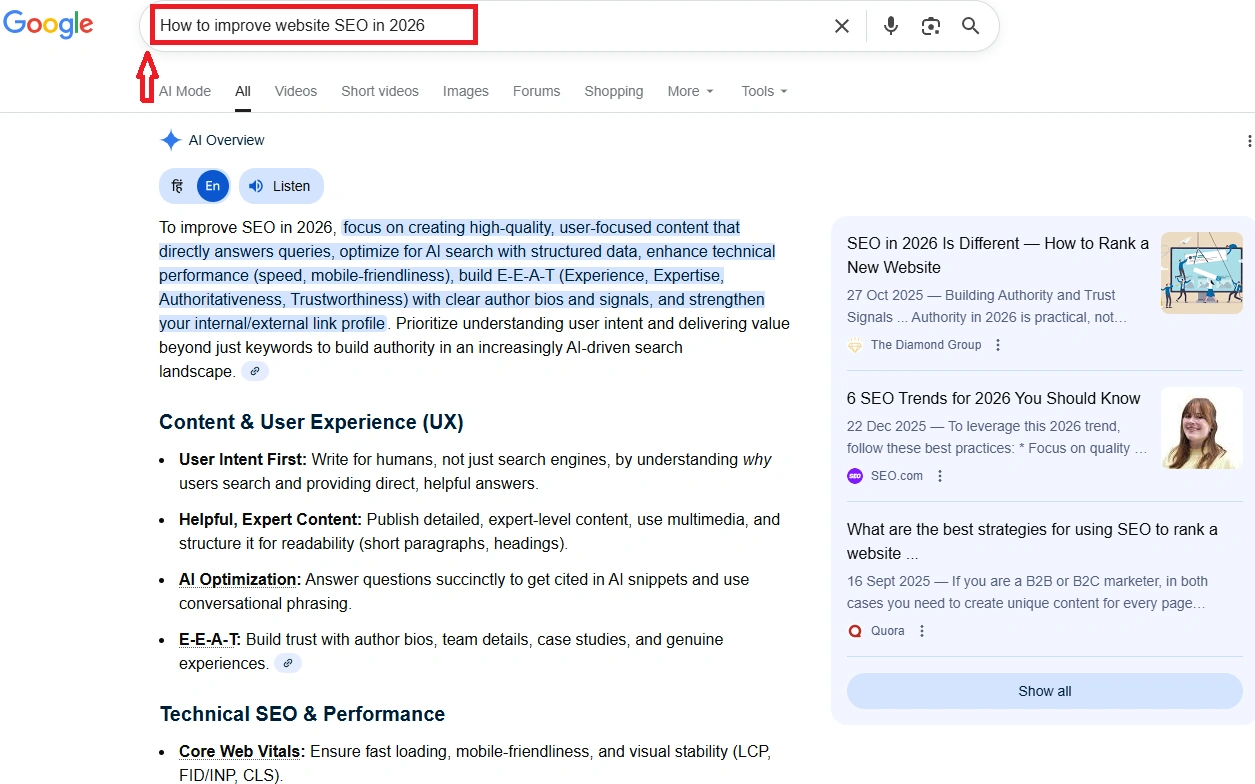
As shown above in the image, Users receive quick answers directly on the search engine results page (SERP), as Google’s AI-powered search. But websites that are not included in the AI snapshot may experience lower clicks than the AI answer. It can result in reduced traffic, even if they rank on the first page of search results. This makes AI visibility just as important as traditional search rankings.
As Google AI Overview continues to reshape search results, businesses need to move beyond traditional SEO and focus on how their content is understood and selected by AI. Google no longer prioritizes content based only on keywords; it evaluates how well it answers user queries and whether it is trustworthy enough to be featured in AI-generated summaries.
To appear in AI-powered search results and build a strong SEO strategy, content must be clear, structured, and aligned with user intent. Here are the key ways to optimize your content for SGE and improve your SEO performance:
SGE is designed to understand the intent behind a search, not just match keywords. Instead of focusing on exact keyword phrases, it evaluates whether your content truly answers the user’s question in a clear, complete, and helpful way. As search behavior becomes more conversational, users are asking full questions rather than typing short queries. Content that directly addresses these questions is more likely to be selected for AI-generated summaries.
What to do: Instead of targeting a broad keyword like “SEO tips,” create content around a specific query like “What are the best SEO strategies for Google AI Overview in 2026?” and answer it clearly in the first few lines. This makes your content more aligned with how AI systems select answers
SGE prefers content that is easy to read, scan, and understand. AI systems don’t interpret content the way humans do—they rely heavily on structure to identify key information. If your content is cluttered, too dense, or poorly organized, it becomes harder for AI to extract useful insights. On the other hand, well-structured content increases the chances of your information being picked and displayed in AI-generated summaries.
What to do: A blog that explains a topic using sections like “What it is,” “Why it matters,” and “How to do it” is much easier for AI to understand than a long, unstructured block of text. This kind of formatting makes your content more likely to appear in AI-powered search results.
Not all content is treated equally in AI-driven search. Google looks for signals that show your content is created by someone who actually knows the subject and can be trusted. That’s where E-E-A-T (Experience, Expertise, Authority, and Trust) comes in—it helps Google decide whether your content is reliable enough to be featured in AI-generated answers.
What to do: If two articles explain the same topic, the one written by an experienced professional with real examples will be more likely to appear in the AI Overview than a generic blog with no clear authority.
Surface-level content is no longer enough to stand out. When multiple sources talk about the same topic, AI systems tend to favor content that explains things more clearly, covers multiple angles, and actually helps the reader understand the subject better. Content that feels complete and insightful has a higher chance of being selected for summaries.
What to do: Instead of just defining “AI SEO,” explain how it works, why it matters in 2026, and how someone can apply it step by step. A well-rounded explanation increases the chances of your content being picked for AI-generated results.
Getting to the top of search results is no longer the only goal. With AI-generated summaries appearing first, users often get their answers without clicking on any links. This means even high-ranking pages can miss out on traffic if they are not part of the AI overview. The focus has now shifted from just ranking higher to being visible where users actually look first.
What to do: A blog ranked #3 but featured in the Google AI Overview can attract more attention than a #1 ranking result that is not included in the AI summary. This shows why visibility in AI results is becoming more important than traditional rankings.
A strong technical foundation ensures your content is easily accessible and understandable for search engines. Without it, even high-quality content may struggle to appear in AI-driven results. Even the best content won’t perform well if your website has technical issues. Google needs to crawl, understand, and access your content easily. A technically strong website helps AI systems process your content more efficiently for summaries.
What to do: If two websites have similar content, the one that loads faster, is properly optimized, and easier to crawl is more likely to be selected by Google AI for its overview results.
In AI-driven search, trust plays a major role in deciding which content gets featured. When other reputable websites link to your content or mention your brand, it signals that your information is valuable and credible. These authority signals help Google recognize your website as a reliable source, increasing the chances of being included in AI-generated summaries.
What to do: If your article is referenced by a well-known SEO blog or a trusted digital marketing website, it strengthens your credibility. This makes it more likely for your content to be considered by Google AI Overview when generating answers.
Content that stays fresh and up-to-date has a better chance of being trusted and selected. As search trends and information evolve, outdated content becomes less useful. AI systems tend to prefer content that reflects the latest insights, making regular updates an important part of maintaining visibility.
What to do: A blog written in 2024 about SEO may lose relevance if it doesn’t include updates about AI-driven search in 2026. Updating it with current trends increases its chances of being featured in AI-generated results.
The future of search is already here—and it’s powered by AI. Now is the time to rethink your content strategy and stay ahead of the curve.
AI-powered search is transforming how users interact with search results, making traditional SEO alone no longer enough. As AI-driven summaries become more prominent, visibility now depends on content quality, structure, and trust. To stay competitive in 2026, businesses must focus on creating clear, valuable, and user-focused content that aligns with evolving search behavior. Adapting early to this shift will help maintain visibility and ensure long-term success in an increasingly AI-driven search landscape.