

Written By Virtuosity Editor Team
Updated 12 May 2026
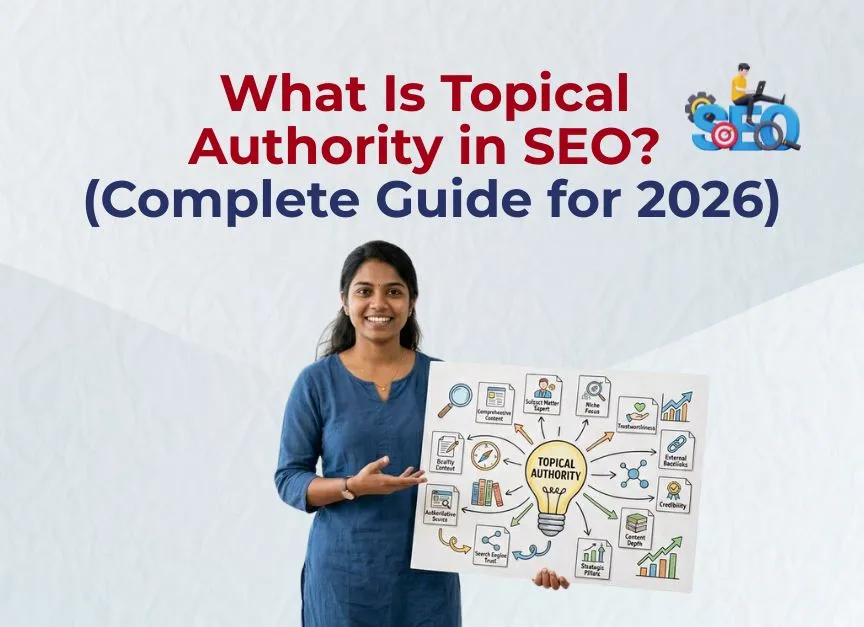
Topical authority refers to how strongly a website is recognized as an expert in a specific subject area. Instead of publishing random articles, successful SEO now requires building complete, well-structured content ecosystems that fully cover a topic and its related subtopics. Hence, topical authority in SEO helps search engines understand that your site offers reliable, comprehensive answers, leading to higher rankings, stronger visibility, and long-term traffic stability.
With this guide, we will help you understand what topical authority is, why it is the most important SEO metric in 2026, and how to create a topical authority map that helps you dominate your industry sustainably.
In technical terms, Topical authority is a measure of a website’s depth of knowledge on a specific subject. It is the perceived expertise a site has gained by covering a topic so thoroughly that search engines consider it a go-to resource.
To illustrate, if a website has 100 high-quality articles covering every possible angle of "Electric Vehicles" (from battery tech to charging stations and insurance), that site has high topical authority. When that site publishes a new article about EVs, it will likely rank much faster than a general news site that only writes about EVs occasionally.
Keywords still matter—but in modern SEO, topical coverage is what ultimately decides authority and rankings.
This is because AI models don't just look for words; they look for entities and relationships. Search engines now use Natural Language Processing (NLP) to understand that if you are talking about "Espresso," you should also probably mention "Grind size," "Barista," "Pressure," and "Tamping." If your content covers all these related "entities," Google views you as a trusted authority. The rise of AI-driven search, such as Google’s Search Generative Experience (SGE), has made topical authority in SEO an integral part. Moreover, Google’s E-E-A-T guidelines (Experience, Expertise, Authoritativeness, and Trustworthiness) are directly tied to topical authority. By covering a niche extensively, you demonstrate "Expertise" and "Authoritativeness." This builds "Trust" with both the user and the algorithm.
Keywords still matter—but in modern SEO, topical coverage is what ultimately decides authority and rankings.
| Old SEO: Keywords | New SEO: Topical Authority SEO |
|---|---|
| Isolated blog posts | Interconnected, structured content |
| Heavy reliance on backlinks | Authority built through depth and coverage |
| Short-term ranking wins | Long-term, sustainable dominance |
A topical authority map is a structured content plan that organizes your website around a central core topic and its related subtopics. It acts as a strategic blueprint that clearly defines your main pillar pages, supporting subtopic content, and the internal linking paths that connect them.
Let’s understand the steps involved in this process;
In this step, you decide the main topic your entire website will focus on. This topic represents your core area of expertise and business identity. All future content will be built around this single central theme.
In this step, the pillar topic is divided into major subcategories called clusters. Clusters help organize large topics into clear sections for better understanding. They also help search engines recognize the breadth of your topic coverage.
In this step, you identify detailed questions users commonly search for. These questions represent specific search intent and long-tail keywords. Answering them helps build depth and trust within each cluster. For each cluster, find every question a user might ask. Use a topical authority map to visualize these connections.
In this step, you connect all related content using internal links. This creates a clear relationship between the pillar and cluster pages. It helps search engines crawl, understand, and trust your content structure. This is the most critical part of topical authority in SEO. You must link all your cluster pages back to your main "Pillar" page and link related cluster pages to each other.
Understanding what is topical authority also means knowing what it is not.
To build a professional topical authority map, you can use several tools:
| Tool | Best Use Case |
|---|---|
| AnswerThePublic | Great for finding the specific questions people ask. |
| Ahrefs / Semrush | Use the "Content Gap" tool to see what your competitors are covering that you are not. |
| LowFruits | Designed to find weak spots in SERPs where niche sites can rank easily. |
| XMind / MindMeister | Useful for visually creating topic cluster maps. |
Topical authority is the foundation of successful SEO in 2026. By focusing on depth, structure, and relevance, websites can build long-term trust with search engines. Creating a clear topical authority map helps eliminate content gaps, improve rankings, and establish your site as a trusted expert within its niche.